

Ratefinding in MICE Procurement: Why Negotiated Rates Alone Don't Mean Savings

Contents
Only 6% of travel managers review their negotiated hotel rates monthly. When rates are audited, 17% show discrepancies between the contract and the system rate, and where they do, companies pay, on average, 14% more than agreed, 11% in Europe. We explain what ratefinding really means, why a negotiated rate alone doesn't necessarily translate into savings, why the rates have to reach your employees, and what you can do about it now.
A framework agreement has been negotiated; the rate is on paper. Very few companies have anyone systematically checking whether that rate is still accurate a year later, whether it matches the actual room rate booked, and whether it hasn’t long since been quietly adjusted by a hotel. This is precisely where ratefinding comes in, and that’s exactly why it should be the starting point for any strategic approach to MICE procurement.
And it is getting more expensive right now: according to the Hotel Monitor 2027 by American Express Global Business Travel, hotel prices will keep rising next year, for example by 3.1 to 4.7% in Frankfurt and 3.6 to 5.4% in London. Every unnoticed deviation weighs more, and for many companies the negotiation round for their 2027 framework agreements is starting now.
What exactly is Ratefinding?
Ratefinding refers to the systematic negotiation and establishment of rates, such as room rates, conference packages, or catering rates, with selected hotels and venues before a specific event is booked. The difference from the traditional individual inquiry is fundamental: Instead of renegotiating for each inquiry, terms are agreed upon in advance based on the expected total volume.
At first glance, this sounds like a one-time procurement project, but it is anything but: it is not a one-time effort. Bargaining power arises only when booking volume is consolidated and visible across locations and departments. As long as each department books individually, no one knows the actual total volume, and without volume, there is no leverage to secure better rates. Ratefinding is therefore only made possible through a strategic process: Centralized demand registration creates the database upon which rates can even be negotiated. Digital platforms then aggregate hotels, venues, supporting programs, transportation, and catering, enabling a direct comparison of offers in real time rather than through scattered email inquiries. AI-powered tools accelerate both the selection of service providers and the evaluation of offers by automatically comparing prices, availability, and contract terms.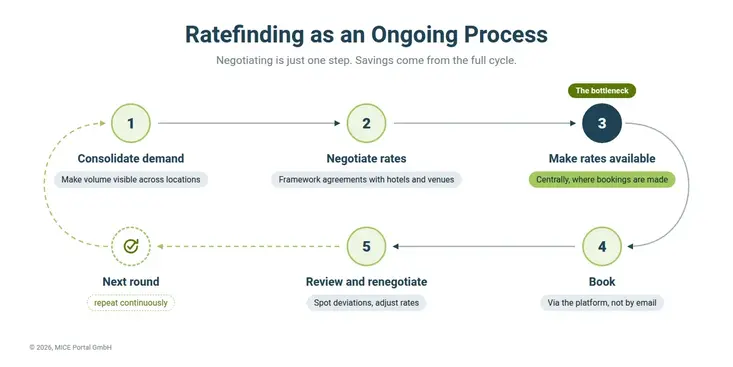
The Real Problem: A Negotiated Rate Isn’t Necessarily a Guaranteed Rate
The widespread assumption in MICE procurement is that once a rate has been negotiated, the savings potential has been realized. That assumption falls short. The real challenge begins afterward: Is the agreed-upon rate actually adhered to in day-to-day bookings? Does it deviate over the term of the framework agreement? And does anyone even notice?
A survey by the GBTA Foundation in collaboration with HRS Global Hotel Solutions among 418 travel managers (conducted in 2017) provides reliable figures on this: 86% of the travel managers surveyed state that they generally audit negotiated hotel rates as soon as they are entered into their systems. However, only 6% do so monthly, and a mere 3% weekly. The vast majority therefore check rates irregularly rather than continuously. When audits are actually conducted, they reveal discrepancies between the contract and the system rate in 17% of cases. And when an error is found, companies pay an average of 14% more than was actually agreed upon, slightly less in Europe (EMEA) at 11%, the same as the global average in the U.S. and the Asia-Pacific region (14% each), and significantly more in Latin America (18%).
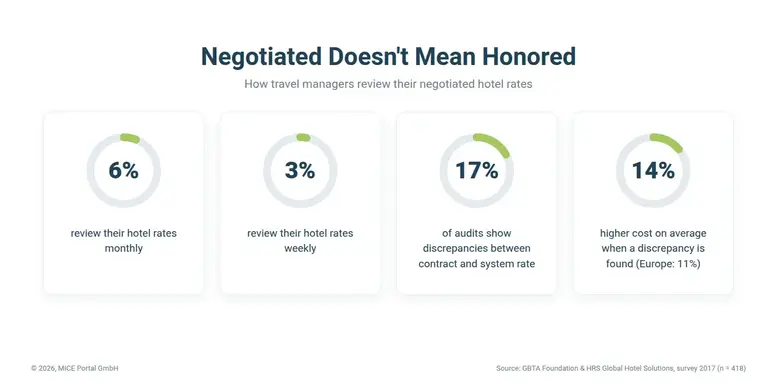
The core thesis for strategic MICE procurement is therefore this: it is not the bidding process that determines the savings, but what happens afterward. And that starts with a question hardly any tender asks.
The Real Bottleneck: How Do the Rates Reach Your Employees?
Imagine your company has 15,000 employees and framework agreements with numerous hotels. How do your colleagues even find out which hotels you have contracts with and which rates apply there? Without a booking platform and without your own hotel database, the question comes up quickly: where do you store the rates, and how do you share hotels and prices with everyone who books?
In practice, negotiated rates usually end up in an Excel spreadsheet somewhere on SharePoint. You can count yourself lucky if employees know the list exists, and luckier still if they actually remember to check it before booking.
Ratefinding can also be used without a digital booking platform, purely as a tool to negotiate rates. But the real problem starts afterward: what happens to the negotiated rates, and how do they reach your colleagues? If everyone keeps picking up the phone or sending an email and booking hotels on their own, there is no way to see whether the rates are being honored. Even the best negotiation brings no savings if it never reaches day-to-day booking.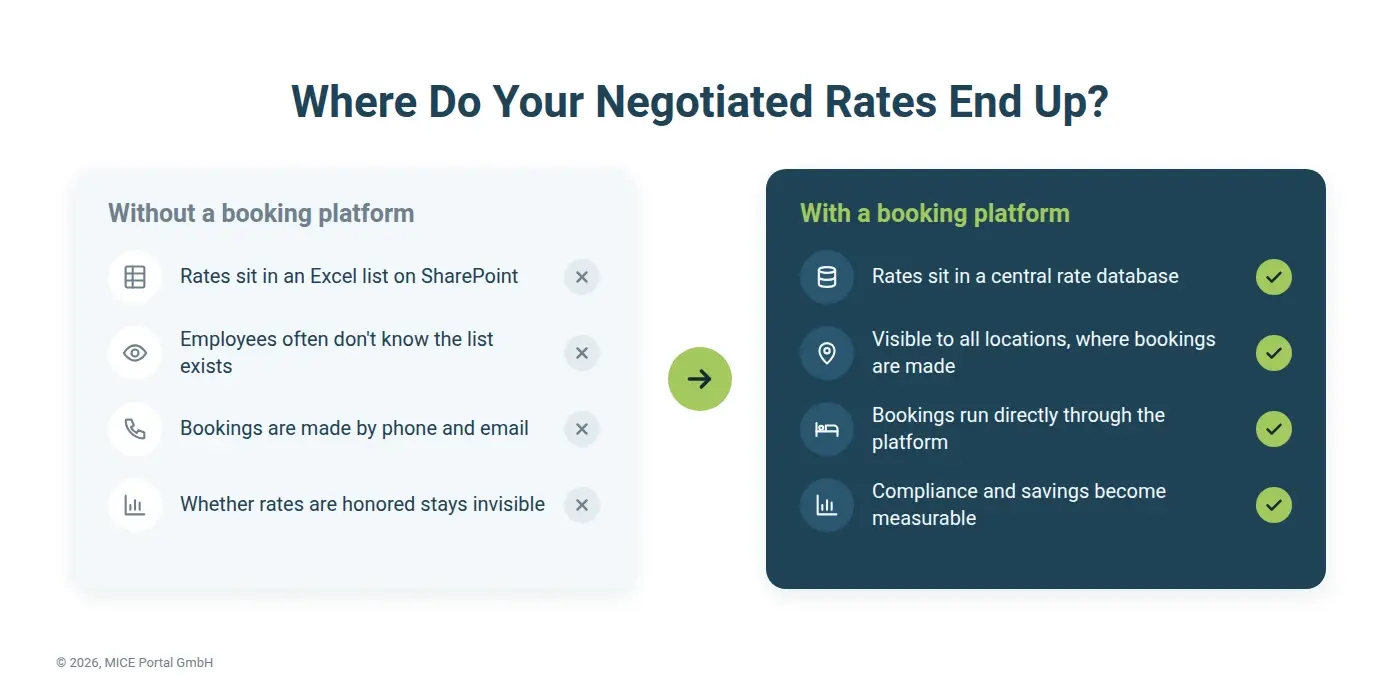
Manual vs. Digital: Where Savings Get Lost?
In practice, the difference is clear. The standard market approach consists of fixed rates without ongoing monitoring, maintained in Excel spreadsheets, communicated via back-and-forth emails, and spread across fragmented individual tools. There is no end-to-end process, only partial solutions for individual steps.
A digital approach like the MICE Portal Ratefinder covers the entire process end-to-end: analyzing the rate portfolio, comparing rates centrally, and renegotiating directly with the hotel, all without any disruption between steps. In practice, this involves three recurring steps: continuously reviewing rates and terms, making discrepancies visible, and renegotiating directly where they occur rather than silently accepting them. Detailed information on how it works and practical examples can be found in the MICE Portal’s Ratefinder knowledge base.
The decisive difference, however, comes from connecting it to the booking platform: the negotiated rates are then not in a separate list but in a central rate database that all locations can access, exactly where bookings are made. Only then does it become visible whether the rates are actually used and honored day to day.
What You Can Measure: Six Types of Savings
When bookings run through the platform, savings are no longer estimated but documented per booking. MICE Portal reporting distinguishes six types of savings:
- Framework agreement saving: negotiated or renegotiated rates are applied to every booking, and the saving is recorded in the system.
- Promotion saving: a framework partner adds a promotion with a special price for a specific service.
- Difference to rate: the framework partner undercuts the negotiated rate.
- Spot saving: when an offer is renegotiated, the supplier lowers the price for the same service.
- Operational saving: benefits that can't be measured through the services in the offer, such as a room upgrade.
- Won & lost saving: booking the cheaper of several comparable offers creates a won saving; booking the more expensive one creates a lost saving.
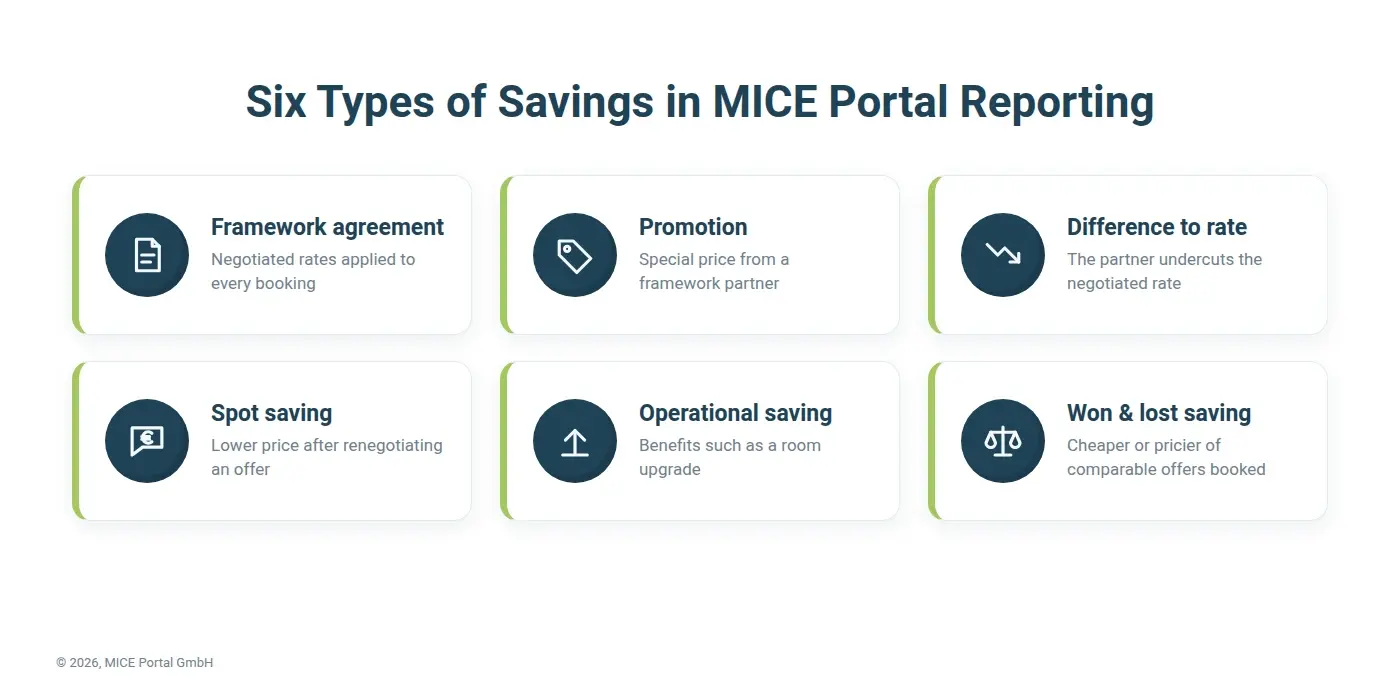
For procurement, this means the impact of ratefinding becomes transparent and can be demonstrated in internal reporting.
What You Can Do Now: A Five-Step Rate Check
You don't have to wait for the next tender to see where your rate portfolio stands. A first check takes little effort:
- Check where rates are stored: Find out where your negotiated rates are kept today and whether employees can find them there.
- Identify your top hotels: Determine the ten hotels with the highest booking volume.
- Compare rates: Compare the contracted rate with the rates actually booked over the last three months.
- Address deviations: Document any differences and clarify them directly with the hotel.
- Use the results: Take your findings into the 2027 negotiation round.
A Real-World Example: DATEV
The effectiveness of this approach is demonstrated by the example of DATEV eG. The company began using the MICE Portal Ratefinder three to five years before the actual launch of its full-scale booking platform, initially solely to centrally solicit and negotiate hotel rates in the MICE sector. This early phase established the data foundation upon which the subsequent, fully integrated solution could be built. Today, 90 to 95 percent of all hotel bookings at DATEV are processed centrally via the MICE Portal, and the framework agreement savings achieved through Ratefinder are still evaluated quarterly and incorporated into internal procurement reporting. Read the full case study: how DATEV makes MICE procurement smart →
Outlook: Establishing Ratefinding as an Ongoing Process
Ratefinding is therefore not a project that ends with the signing of a framework agreement, but rather a capability that an organization builds: the ability to generate bargaining power through aggregated volume, to bring the negotiated rates to where bookings are made, and the discipline to continuously review the results of those negotiations thereafter. Anyone who skips one of these steps forfeits a significant portion of the actual savings potential in MICE procurement.
The MICE Portal Ratefinder illustrates in detail how this can look in practice within your own organization, from the request for proposals to the central rate database to ongoing renegotiation. A tool guide detailing the individual steps, as well as an in-depth explanation of why efficient rate negotiation is so crucial in hotel procurement, is available on the MICE Portal’s Knowledge section.
Talk to Pia Sielaff, she’ll be happy to show you exactly what Ratefinder means for your MICE procurement and where discrepancies likely already exist in your rate portfolio today, without anyone having noticed. Get in touch →
Sources:
-
Are Corporate Travel Programs Getting the Hotel Rates They Negotiate?, GBTA Foundation & HRS Global Hotel Solutions, survey 2017 (n = 418)
-
Hotel Monitor 2027, American Express Global Business Travel, via Business Traveller (29 Sep 2026)
-
MICE Portal Ratefinder (product page)
-
MICE Portal Knowledge: Ratefinder
-
MICE Portal Knowledge: Efficient Rate Negotiation for Hotel Procurement
-
MICE Portal Knowledge: Ratefinder Tool Guide
-
DATEV eG Customer Success Story, MICE Portal (26 May 2026)
Want to know more?
Book a personal consultation