

Strategic MICE Management
The Framework for Company-Wide Event Procurement

MICE (Meetings, Incentives, Conventions, and Exhibitions) is the last major product category that many companies have not yet begun to procure in a structured manner. Business travel, including individual overnight stays and mobility solutions such as flights or rental cars, has long been digitized, negotiated, and managed in compliance with regulations via OBEs (Online Booking Engines). In contrast, MICE procurement is not yet formally integrated into the procurement processes of many companies and therefore often operates outside established procurement structures. Contact with vendors usually takes place directly via email and phone, contracts are signed manually, and they are managed in Excel spreadsheets. This behavior is referred to as “maverick buying”: uncoordinated procurement that bypasses central processes, framework agreements, and approval workflows. Strategic MICE management applies the principles of travel management to event procurement: a model that enables you to create spend transparency, reduce compliance risks, and gradually consolidate your event procurement company-wide.
What Is Strategic MICE Management?
Strategic MICE Management is a management framework that supports companies on their journey toward company-wide, centrally managed event procurement. It provides travel managers and procurement professionals with concrete guidance on how to evaluate and systematically track the MICE category within their own company. The path to achieving this is, at its core, applied change management, tailored to the specific characteristics of MICE procurement, with a clear goal: to consolidate event procurement company-wide and bundle it into a central MICE booking platform that integrates seamlessly into the existing travel management system landscape.
At the heart of this is MICE Portal’s Flywheel Model: a controllable MICE procurement process surrounded by five phases that evolve with each rotation, rather than ending as a one-time project. Read on below to learn how these five phases work in detail.
For travel managers and procurement professionals, we derive a robust business case from this model, from identifying potential to developing a strategy and implementing it, with arguments that engage and mobilize executive management and other relevant stakeholders in support of the initiative.
Who is Strategic MICE Management for?
Strategic MICE Management is aimed at all companies that want to strategically manage their event procurement to achieve savings, optimize processes, and save time. The focus is primarily on two roles:
Travel Managers: You’ve long had flights, hotels, and individual overnight stays under control, digitized, negotiated, and managed in compliance with regulations. MICE is the next logical step in the role you already fulfill, as you already possess the internal knowledge regarding stakeholders, budgets, and departments that MICE procurement requires.
Procurement teams: You’ve long managed other product categories centrally, using framework agreements, approval processes, and reporting. MICE has been one of the last categories without this level of control, even though the potential for savings is just as high as in other areas.
Strategy Instead of Maverick Buying
Uncoordinated and unmanaged event procurement, known as “maverick buying”, is the first issue that strategic MICE management addresses. Only once maverick buying has been eliminated can cost-saving potential, more efficient processes, and significant time savings be realized. This is made possible by a centralized MICE booking platform that consolidates all event procurement, from service provider selection, through the request and digital reservation contract, to automated billing.
Added Value Through Strategic MICE Management
30% Savings Through Cost Control and Budget Transparency
Centralized MICE management consolidates cross-location and cross-departmental spending, creates transparency, and enables targeted control. Through framework agreements, standardized booking processes, and digital approval workflows, potential savings become visible and budgets are clearly monitored. This allows companies to maintain an overview at all times and avoid overspending. Procurement platforms such as MICE Portal provide the digital foundation for this.
75% Increase in Efficiency and Economies of Scale
Strategic MICE management streamlines processes from vendor selection to billing, reduces administrative burden, and accelerates workflows. Uniform standards ensure consistent quality and facilitate collaboration with trusted service providers. This reduces the workload on employees, minimizes points of contact, and improves predictability, as clearly structured processes significantly reduce the effort required for coordination.
100% Process Reliability and Compliance
Clear guidelines and integrated compliance rules ensure legally sound and reliable processes. Strategic MICE management ensures that all steps comply with internal guidelines as well as external requirements such as the GDPR and the LkSG. This reduces risks, increases transparency, and enables companies to establish a verifiable, sustainable foundation for responsible event management.
Strategic MICE Management
Flywheel Model
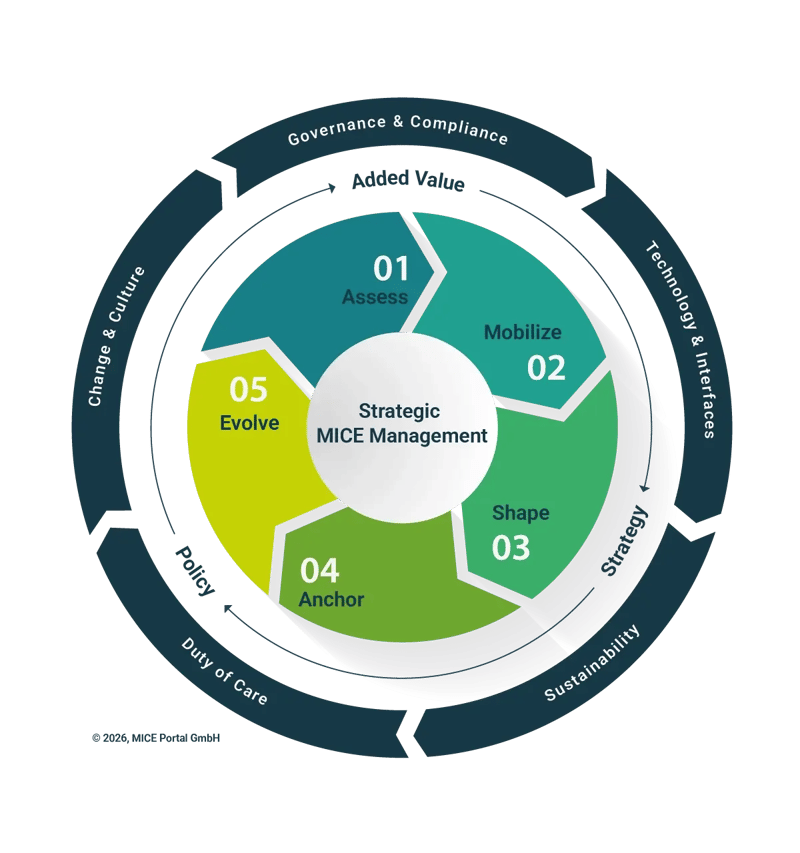
Strategic MICE management is not a project with a beginning and an end, but rather a cycle that reinforces itself with each iteration. A key milestone along this path is the introduction of a centralized MICE booking platform: without it, further consolidation is impossible; with it, however, the foundation is laid upon which every future cycle builds, rather than starting from scratch. The five phases: Asses, Mobilize, Shape, Anchor, and Evolve form the backbone, but the cycle does not stop at the “end”: insights and built-up momentum flow back into the next category, the next region, and the next stage of maturity.
This movement continues from the inside out. The stage of maturity is reflected in the middle ring, in the progression from strategic orientation through binding policies to the realization of added value. At the outer edge, new cross-cutting themes also come into focus with each rotation, initially mostly Governance & Compliance and Technology & Interfaces, and later increasingly also Sustainability, Duty of Care, and Change & Culture. How the five phases interlock in detail and what leverage each one offers is explained below.
An Overview of the Five Phases

1. Assess
Where do we stand today, and what would a structured MICE procurement process look like for us? The first step is to take an honest look at the status quo: How much of the budget actually goes toward meetings, incentives, conventions, and exhibitions, and how much of it bypasses central processes? In this phase, you quantify spending transparency and compliance risks and use this information to develop a target vision. In short: cost efficiency for the company and a high-quality event experience for participants.

2. Mobilize
Who needs to be on board for the project to succeed? Strategic MICE management cannot be achieved alone. In this phase, you identify the relevant stakeholders, from travel and procurement to finance and departments with high event volumes, and actively build a coalition and secure their commitment. A well-founded business case serves as the foundation for attracting high-profile sponsors who will grant the project the mandate it needs for implementation.

3. Shape
What should the new process look like, and which areas are affected by it? Now the vision becomes a concrete concept: requirements and policy design. What technical foundation is needed for this? Framework contract rates must be recorded via ratefinding, and savings must be tracked in real time. This is supplemented by ERP interfaces for approval processes and automated accounting processes (procure-to-pay), which ensure e-invoicing and automatic posting. Only on this basis do market analysis and vendor selection follow.

4. Anchor
How does the new approach become a new habit? The key lies in balancing two things: communication that turns those affected into active participants, and the consistent enforcement of policy and compliance. A well-communicated rollout and a flexible training program, one that includes online formats such as webinars and Q&A sessions form the foundation for this. This is supported by consistently available assistance, such as via phone or chat, as well as a digital knowledge base where everyone can find the information they need on their own.

5. Evolve
What impact does the new process have, and what is the next phase of expansion? KPIs, savings, compliance rates, and utilization rates are specifically leveraged to re-engage stakeholders and kickstart the next phase of expansion. This brings us full circle back to Phase 1, but at a higher level of maturity. With each additional rotation of the flywheel, the focus shifts increasingly from the inside to the outside: Following the basic implementation of the MICE booking platform, depending on the company’s strategy, the cross-functional topics at the outer edge of the flywheel model come more into focus.
These five topics have an impact across all phases of the flywheel. They determine how robustly strategic MICE management is embedded within the company.
Governance & Compliance
A binding event policy governs roles, approvals, and the booking process in a manner that is clear and transparent to all parties involved.
Technology & Interfaces
Through interfaces with existing ERP systems such as SAP, Ariba, OCI, or cXML, Strategic MICE Management becomes an integral part of the existing system landscape. The underlying platform should be ISO 27001-certified and operate in compliance with the GDPR.
Sustainability
Sustainability becomes a key selection criterion for hotels, venues, and service providers, ranging from CO2 reporting to vendor certification.
Duty of Care
A structured MICE procurement process highlights where and when large numbers of employees are gathered in one location, thereby laying the foundation for a systematic duty of care.
Change & Culture
Successful programs engage bookers by offering tangible benefits such as efficiency and time savings in everyday work rather than merely discussing rules.
Your Expert in Strategic MICE Management

Daniel Ritter
MICE Expert | Senior Sales Manager
Schedule a no-obligation consultation with me, and let’s figure out how we can transform your event procurement into Strategic MICE Management!