

MICE Procurement Part 1: An Industry Between Tradition and Transformation
Contents
Why event procurement is the last category that hasn’t been digitalised
Why this article series?
In almost every procurement department, there is one category that everyone knows but nobody truly feels responsible for: events. They are booked by all kinds of departments. HR organises trainings. Marketing plans client events. Sales books conferences. The board needs offsites. Every company buys events, the budgets are substantial, but the process behind them is often surprisingly analogue. That is changing now. And I want to explain why.
We deliberately launched MICE Portal as a procurement platform, not a venue finder. From the very beginning, we focused on the needs of the procurement organisation, not on marketing hotel capacity. As a company that has been in the MICE business since 2000 and built the first web-based event procurement platform in 2004, we understand this process better than most.
MICE belongs to indirect procurement, much like Travel & Entertainment, a category that was long treated as low priority. Travel costs were digitalised first, then traditional indirect materials. MICE is the next step. Many venue finders emerged from hotel marketing and later developed procurement solutions from there. What sets us apart: we start with the buyer. What does the company need to procure in a rule-compliant, efficient, and comparable way? And we cover the entire value chain, from requirements definition to payment.
I want to share this perspective in an article series. How does MICE procurement really work? And where are we heading? Our vision is a European procurement network for MICE. We call it MICE Network: a shared marketplace where suppliers and buyers collaborate across borders. More on that later.
The central question running through every part: does the company procure, or does the platform sell hotel capacity?
What is MICE, and why it is a procurement issue
MICE stands for Meetings, Incentives, Conferences, and Exhibitions, the umbrella term for every type of business event. The term sounds niche, but it describes one of the largest indirect cost categories in enterprises. Industry studies estimate the total German MICE market at 70 to over 100 billion euros. Based on GCB data and our own booking data, we estimate the addressable market for our solution at 14 to 18 billion euros (derivation at the end of the article).
The distinctive feature: 86% of all events remain below 250 attendees. Yet the procurement process for a meeting with 20 people is just as complex as for a conference with 500. That is precisely why digital procurement makes sense for this category: not because of the large events, but because of the many small ones. From about 50 events per year, a procurement tool becomes economically viable.
How has this market been served so far? For a long time, through outsourcing to agencies that had the know-how missing internally. The reason: even for small events, the basket value sits around 8,000 euros. At that level, procurement policies kick in. Add to that laborious research, painful offer comparisons, and the renegotiation trap: the meeting organiser had already decided, but procurement was obligated by policy to renegotiate.
Framework agreements were supposed to fix this. In practice, they often failed: hotels used dynamic pricing and rejected requests at framework rates on high-demand dates. Without technical support, enforcement was not controllable. Agencies remained in use. This is where the origin of what a real MICE procurement tool must deliver lies.
The difference: venue finding vs. procurement tool
A venue finder helps locate a suitable venue. That is valuable, but it is only the first step, comparable to a Google search for conference hotels. A procurement tool covers the entire purchasing process: from requirements definition through RFP, comparison, and approval to booking, invoicing, and payment. Company rules are built in from the start, not bolted on afterwards.
An example makes the difference tangible: a pharmaceutical company must apply different requirements to venue selection depending on the HCP status of an event. Offers must be broken down at the line-item level, not as flat rates, so that EFPIA reporting works and the limits per meal are respected. Approvals must be configured by event type and offer amount. And the invoice must be easy to process and correctly allocated for tax purposes. A venue finder cannot do any of this. This is exactly why clients need their own dedicated procurement environment, a system that knows their requirements.
The fundamental distinction: is the approach buyer-driven or venue-driven? A procurement tool serves the company’s needs. A venue finder optimises for the hotel.
The inverted approach: from requirement to offer
From these insights, we developed MICE Portal as a web-based procurement platform, built on a core principle: turning the process on its head.
Traditionally, the meeting organiser searches for hotels, receives various offers, tries to compare them, and makes a decision that then needs to be approved by procurement. Our approach: the meeting organiser defines their needs in the tool, and company-mandated requirements are applied automatically. Hotels submit offers on this basis: at the line-item level, under the company’s T&C, and with the prescribed cancellation conditions. Offers are comparable from the outset, and the hotel decides for itself whether to submit.
This is standard in B2B procurement: define requirements, tender, compare offers, decide. Why should events be any different? Today, AI makes this approach even more powerful. It can engage with the character and purpose of an event (a creative offsite requires a different location than a compliance training) and suggest suitable hotels within each company’s rules. More on this in Part 3.
Every user should be able to procure independently. Agencies can work on the platform for clients. Framework agreements are enforced by the system, not on trust. And for suppliers, there is a clear advantage: in a standard request, five hotels are contacted, two decline, three submit offers. 33% chance of winning. And payment is reliable because procurement went through the official sourcing tool. No maverick buying, no invoice disputes.
What MICE Portal is today, and where we are heading
From the founding principle (the buyer defines, the supplier responds), a platform has grown over 25 years. An important distinction: the client is the company. Efficiency and transparent procurement are the primary goals. The meeting organiser needs a good user experience so they actually want to use the tool. The attendees should get a good event. But the tool is designed so that the meeting organiser follows the company’s procurement rules. This is what the built-in standardisation delivers: it accelerates the process for all sides while ensuring the rules are respected.
The architecture follows the logic of SAP Ariba: every client operates their own instance (we call it a Shop) with their own data and rules. The suppliers come from a shared marketplace: MICE Network.
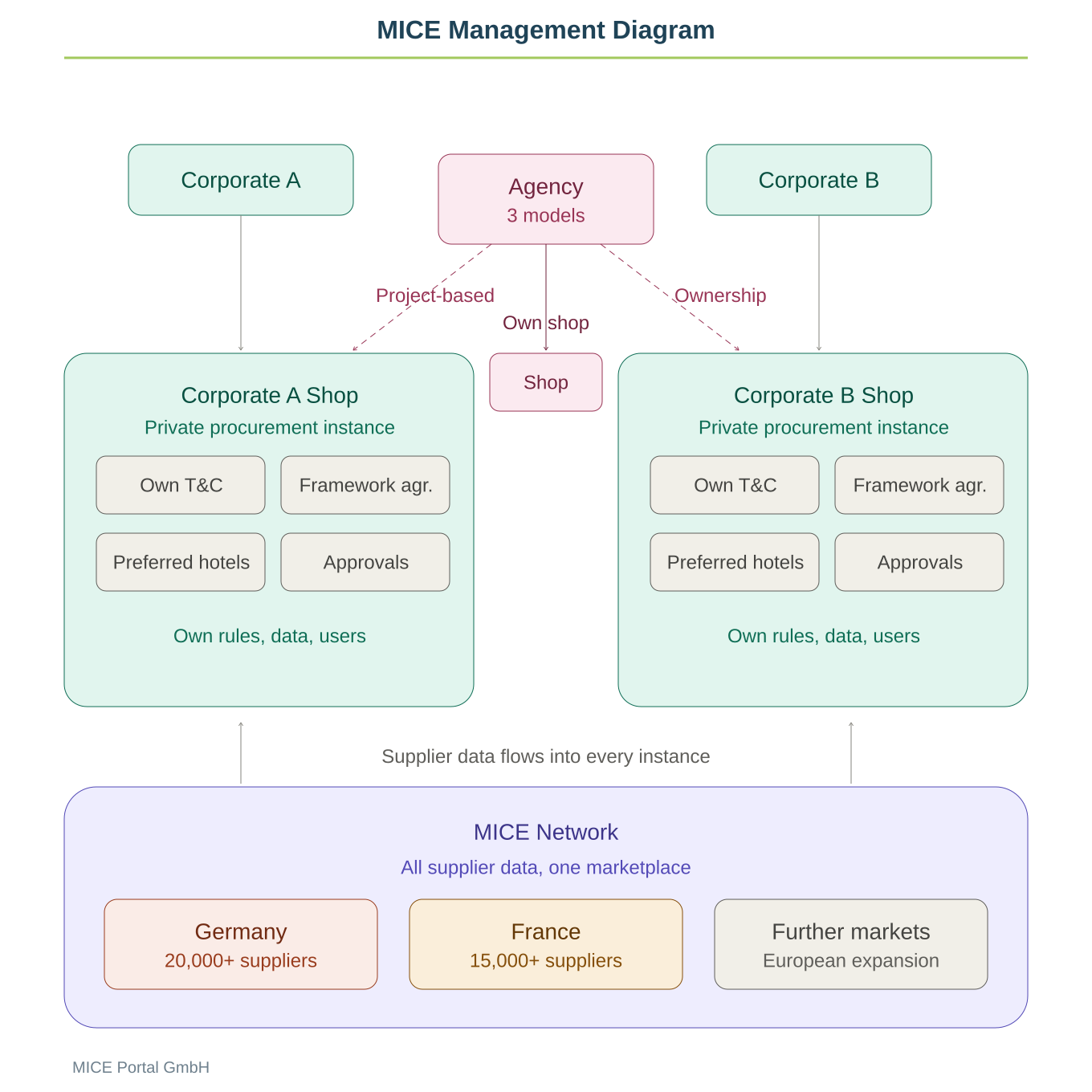
MICE Management Architecture, Database, Procurement Entities, and Agency Model
MICE Network is the shared supplier marketplace underneath every MICE Portal instance. Suppliers register once, accept the digital procurement workflow, and are reachable by every client. Fairness is central: suppliers submit standardised offers at the line-item level. Every client defines their own base contract requirements, determines the negotiation margins they allow toward suppliers, and can register framework agreement partners in their Shop. Every supplier can communicate directly with the client. Our conviction: digitalising this category requires a base set of rules that simultaneously allows flexibility. Only then can a solution scale across Europe.
For the buyer, MICE Network is a B2B procurement network with structured, comparable offers. For the supplier, it is a marketing channel with qualified requests: real procurement transactions with budget and decision-making authority, not non-committal inquiries.
By including all market participants, we create an efficient marketplace. Clients get a compact procurement solution. Suppliers reach all clients through one profile. Agencies can work with their own Shop via MICE Network, take ownership of a client’s Shop, or be booked by clients on a project basis. This includes all parties and creates transparency.
MICE Network: the European vision
There is no unified solution for digital MICE procurement in Europe. No network that brings buyers, suppliers, and agencies together on a single platform across borders. No system that covers the entire procurement process while respecting local and client-specific market conditions. MICE Network closes that gap. Our goal is to build the European infrastructure for digital MICE procurement: one MICE Network, individual client Shops, bringing all market players together.
Our AI hub MICE Core complements this vision and drastically lowers the entry barrier for users. The MICE Conversational Agent executes tasks easily via chat or voice input, from meeting request creation and supplier research to creating offer comparisons, renegotiation, booking, and much more.
Measured savings across all mechanisms: over 25%. These are not projections but values from 15 years of enterprise clients.
What comes next
This first part has set the stage. In the coming articles, I will dedicate one piece to each key player and topic in the MICE procurement ecosystem:
-
Corporates. What matters for procurement teams, how to run a proper MICE Management implementation, and what to watch out for.
-
Suppliers. Their role in the ecosystem, reservations about digital procurement, the commission question, and the benefits of participating.
-
Agencies. How to properly integrate them into the tool, what working models look like in practice, and common reservations.
-
AI in procurement. What role AI plays in MICE sourcing today, where it delivers real value, and where it does not.
-
The travel ecosystem. How MICE fits into the broader corporate travel and IT landscape.
-
Invoicing and payment. Why event invoicing is so complex and how to solve it.
-
Reporting and total cost of event. What savings are real, how to measure them, and why the total cost of an event is the metric that matters.
Next up: the perspective of corporate procurement. Few transactions, high basket values, and the question of why MICE is so much harder for procurement than any other indirect category.
Sources and derivation: Total market: ghh consult/GCB study (€82bn), R.I.F.E.L./IGVW study (€114bn for business-related events). Addressable market for MICE Portal (€14–18bn): Own derivation based on Meeting & EventBarometer Germany 2024/2025 (GCB/EITW/EVVC), 1.7m in-person events, 50% corporate share, 90% domestic organisers, segment up to 500 attendees, applied to our average event costs per size category (actual booking data)..
Want to know more?
Book a personal consultation