

From the Borsig Model Farm to Europe’s Greenest Conference Venue: A Profile of the Stober Estate
Contents
How a historic estate in Havelland became a brand in its own right, and why SEO and MICE portals are now replacing what the carrier pigeon used to do.
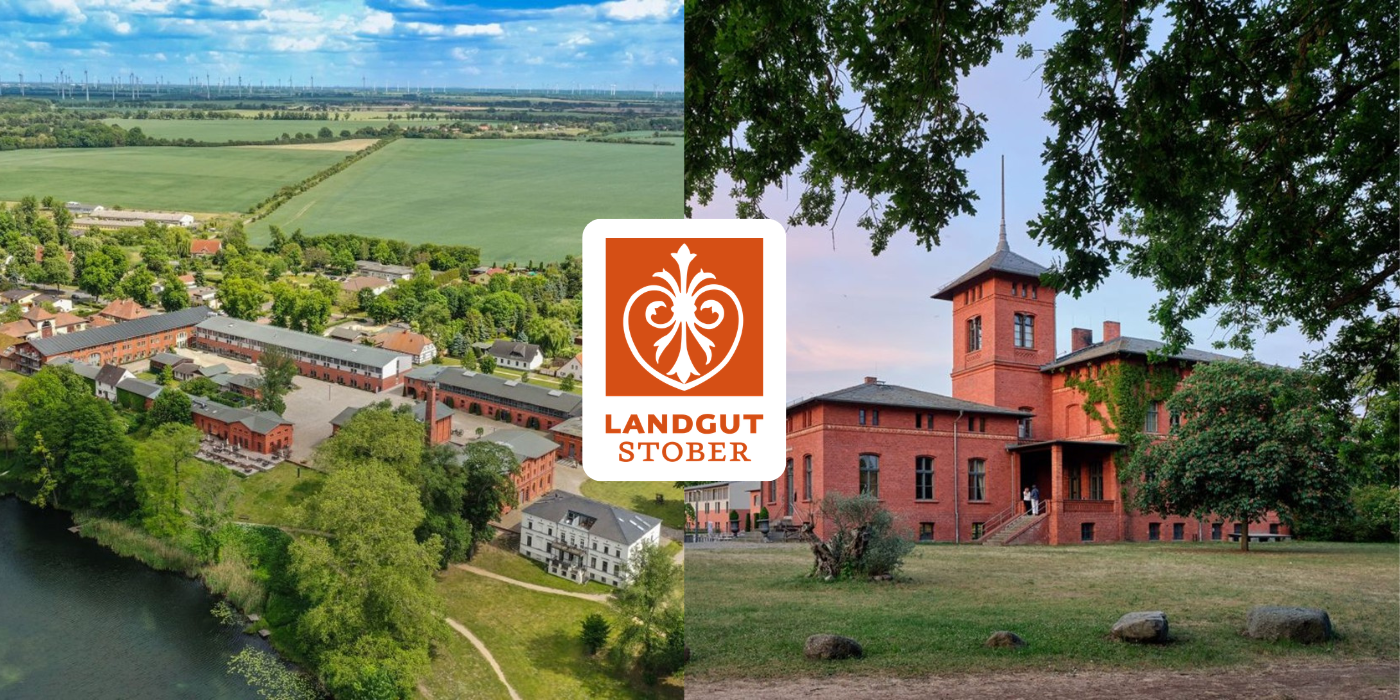
There are places whose history is more than just an advertising argument. The Stober country estate in Brandenburg's Havelland region is one of them: a historic location directly on the lake, surrounded by old parkland. Back in 1866, industrialist Albert Borsig, the king of Prussian locomotives, bought the then 2,700-hectare estate in Groß Behnitz. His aim was to supply the factory canteens of his several thousand Berlin workers with vegetables and potatoes from his own farm. As telephones did not yet exist, orders from the capital were reportedly sent by carrier pigeon. The delivery route was supplemented by a specially built railroad line, which was later extended to Magdeburg. This illustrates just how advanced Borsig’s logistics were 160 years ago.
A few decades later, in October 1941, history of a completely different kind came together on the same site. Ernst von Borsig junior, great-grandson of August Borsig and landowner since 1933, invited members of the Kreisau Circle to Groß Behnitz. Helmuth James von Moltke, Peter Yorck von Wartenburg and Adam von Trott zu Solz were among the guests. For three days, they thought about a world after National Socialism. Most of them later paid for their resistance with their lives. Borsig himself died in Soviet captivity in September 1945.
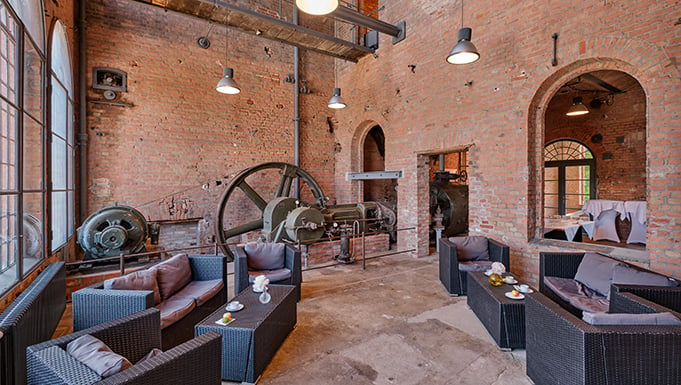
Peter Stumpf (Landgut Stober) - Fat Bertha
Today, 85 years after these conferences, this very place has become the most sustainable conference location in Europe The ruin, which Michael Stober took over from the Treuhand in 2000, was not turned into a classic hotel, but into a dedicated conference destination with 300 rooms, 30 conference rooms and around 200 employees. Climate balance sheets since 2013, GSTC certification from the UN, economy for the common good as an accounting model. Sustainability is not a communication discipline here, but influences investments, profit distribution and management. It is precisely this attitude that also shapes the hotel's sales and marketing strategy, which owner Michael Stober and marketing lead Sina Richter talk about in an interview with MICE Portal.
95 percent MICE and with conviction
Today, carrier pigeons have disappeared from everyday conference life, but the specialization of the Borsig generation lives on. Anyone running a hotel with 300 rooms, 30 conference rooms, four kitchens and a restaurant with a lakeside terrace on an extensive site on Lake Groß Behnitz is faced with an obvious task. All these capacities must be reliably utilized, otherwise the model will not be economically viable. Landgut Stober has found a clear answer to this, which also shapes its identity. An attempt to open up the house more to individual tourism quickly failed in practice. In practice, combining conference guests and leisure travelers under the same roof turned out to be difficult.
"The conference guest wants to party in the evening and have some excitement, while the leisure tourist wants to enjoy nature in peace in the morning along with their organic breakfast. If you can’t completely separate that, it simply doesn’t work."
Michael Stober
Hotel Director | Landgut Stober GmbH & Co. KG
The consequence is clear. Landgut Stober does not see itself as a hotel with a few conference rooms, but as an independent event destination. 95 percent of turnover comes from the MICE sector, of which around 10 to 15 percent comes from weddings. This clear specialization is not a random market reaction, but the result of a conscious decision. It allows a focused customer orientation and makes the hotel a genuine specialist for event planners.
Sustainability as a business model
What many hotels do as sustainability marketing is deeply rooted in the business model at Landgut Stober. Climate assessments have been carried out since 2013, and the hotel was awarded the title of "Greenest Hotel in Europe" from 2017 to 2021. The hotel is currently focusing on achieving certification by the Global Sustainable Tourism Council (GSTC), one of the toughest awards in the world.
But ecological sustainability is only one of three dimensions. Landgut Stober operates according to the principles of the Economy for the Common Good. This economic model, founded by Christian Felber in 2010, does not focus solely on financial profit, but on a company's contribution to the common good. Values such as human dignity, solidarity, social justice, ecological sustainability and democratic co-determination are assessed. Where a traditional balance sheet asks how much the company has earned, the common good balance sheet asks what value the company has created for employees, customers, suppliers, society and the environment.
While many companies talk about responsibility, at Landgut Stober it is firmly anchored in the distribution of profits. According to the company’s current model, 20% is reinvested directly into employees through higher wages and social benefits, another 20% is donated to humanitarian and charitable causes, and 40% is retained for reinvestment into the business. The remaining is used for special repayments to the sustainability bank and to remunerate the two owners Tanja Getto-Stober and Michael Stober. Social responsibility is not an image department here, but a fixed balance sheet item.
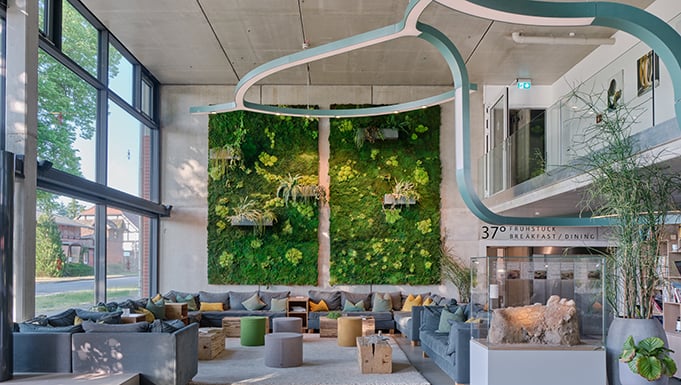
© Peter Stumpf (Landgut Stober)- Lobby visual axis Mooswand
This attitude also has an outward effect. An internal guest survey conducted several years ago showed that 25 percent booked the hotel precisely because of its sustainability. Today, the proportion is likely to be significantly higher, as more and more companies require reliable evidence of climate-neutral conferences for their ESG reporting. The Landgut is able to provide this documentation after each event.
Marketing comes first, sales follows
While many hotels have a strong sales focus and outsource their marketing to external agencies, Landgut Stober takes the opposite approach. With two in-house marketing professionals, the hotel manages the entire communication mix itself. Website, SEO, print, PR, social media and, above all, environmental communication, which is becoming increasingly demanding for SMEs under stricter EU requirements. Only recently has the company is only now expanding its direct sales with an additional full-time employee.
"SEO is a key lever for us. Anyone in Germany searching for a sustainable conference hotel ends up with us pretty quickly."
Sina Richter
Marketing Manager | Landgut Stober GmbH & Co. KG
MICE portal as a reach booster
Booking portals have a clear function for the Landgut: reach beyond its own website. This is precisely the point that Sina Richter emphasizes with the MICE portal.
"Through such platforms, we reach customers we otherwise wouldn’t reach at all—or only with difficulty. Especially large clients who submit inquiries exclusively online. Without them, we would completely miss out on this customer segment."
Sina Richter
Marketing Manager | Landgut Stober GmbH & Co. KG
There is also a practical advantage in day-to-day business. All relevant key data is sent directly to the event team in the correct format via the structured input mask. This saves time in the quotation process, which, according to Richter, is the biggest time waster in sales. Where the carrier pigeon used to take days, the MICE portal now sends a complete inquiry in seconds.
Fair partnership with portals
Enthusiasm for portals is not universal. Stober and Richter draw a clear line between reach partners with fair conditions and providers whose commissions put structural pressure on profitability. The company considers a commission in the region of 10 to 15 percent on agency business to be balanced. Such conditions can be calculated and enable genuine cooperation on an equal footing.
The situation is different with some large booking portals, some of which operate internationally, which charge commission rates well above the 20 percent mark in the conference sector. Such conditions upset the balance because they structurally erode the hotels' margins and make a genuine partnership more difficult. There is a reason why the Landgut can afford to take a critical position here. The strong brand and the consciously cultivated direct sales make it largely independent of individual sales channels. The estate consciously uses portals as a supplement to its own marketing - not as an economic dependency.
It is precisely from this position that a fair partnership with selected portals is important to the estate. Reach, yes, but on terms that benefit both sides. This is exactly what Landgut Stober appreciates about the MICE portal.
"MICE Portal has been a reliable partner for us for many years. What began as an additional sales channel is now an integral part of our marketing strategy. Our collaboration takes place on equal footing, and the results speak for themselves: through the platform, we reach customers who often would not have found us through traditional channels."
Michael Stober
Hotel Director | Landgut Stober GmbH & Co. KG
48 hours to the quotation
Despite all the discussion about AI and interfaces, the preparation of quotations at Landgut Stober remains manual work. 30 very individual conference rooms and top customers who hardly ever make standard requests require personal attention. The hotel has set itself a clear service level.
"48 hours to a finalized proposal—reliably delivered. For many clients, a noticeable difference compared to the competition."
Sina Richter
Marketing Manager | Landgut Stober GmbH & Co. KG
A conference venue with depth
Landgut Stober shows how a medium-sized conference hotel can remain successful in the long term with a clear attitude, consistent brand management and a conscious channel mix. Anyone planning an event that is intended to be more than just an interchangeable conference container with catering will find an address with historical depth, ecological substance, its own identity and an operating model that is rarely found in its consistency. It takes around 30 minutes by car from Berlin, and the site on Lake Groß Behnitz offers the right setting for everything from an intimate four-person group to a large event with over 700 participants - supplemented by around 12,000 square meters of outdoor space for even larger formats.
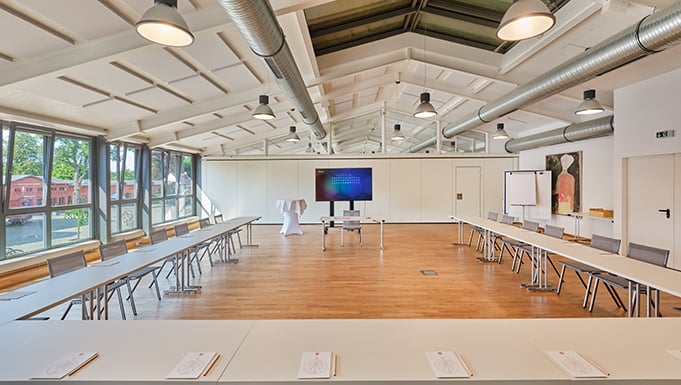
© Peter Stumpf (Landgut Stober) - Exemplary conference room
If you would like to get a first impression, you can find the complete profile with meeting rooms, pictures and contact details directly in the MICE portal: Discover Landgut Stober in the MICE portal.
Want to know more?
Book a personal consultation