


Contents
MICE is an essential term in the hotel industry.
It is also a key economic sector for hotels, the hospitality industry and companies with a large turnover.
More than just turnover: an influence on the economy, the promotion of innovation and the opportunity to establish strong networks and drive forward a wide range of industries - MICE has it all. If you want to find out more about the background, trends and potential of the MICE sector in the Business to Business (B2B) segment, this is the perfect introduction!
1. What does MICE actually stand for?
"MICE" is anacronym consisting of the first letters of the terms: Meeting, Incentives, Convention and Exhibitions. Worldwide, the term MICE is predominantly used in connection with an entire industry, i.e. the MICE industry. It is also often used as a synonym for the event industry. This term encompasses all providers and participants from hotels, event locations, trade fair suppliers, event technology sppliers, agencies, team experience suppliers, transfer service suppliers and many more, who together provide services relevant to events. It is through them that an event becomes a unique experience.
The exact origin of the term "MICE" is not clearly documented, but the acronym became popular in the 1980s when the importance of business events and their economic impact was increasingly recognized. The use of the term is often associated with the development of the event and convention industry, which became highly professionalized during this period.
In addition to the MICE industry, the term "MICE market" is also often used, which focuses on the marketing of event modules and finished events. The MICE market primarily refers to Business-to-Business (B2B) events, specializing in MICE formats such as conferences, congresses, trade fairs, educational events and similar events that serve the purpose of sales promotion, knowledge transfer and motivation, for example.
Overall, the MICE industry is a significant part of the global economy, with Europe alone accounting for more than half of the international volume at around USD 470 billion.
2. The four pillars of the MICE industry:
The MICE industry is diverse and encompasses a wide range of events that pursue business, motivational or even social objectives. It is divided into four central areas: Meetings, Incentives, Conventions and Events. These main categories cover everything from planning strategic business meetings and creative motivational programs to large international conferences and inspirational events.
Each of these areas fulfills a unique function while contributing to the common goal: Bringing people together, fostering innovation and building lasting connections.
3. Why is MICE so important for companies?
MICE events are a strategic tool for many companies to drive business growth, innovation and employee retention. However, despite the immense benefits that meetings, incentives, conventions and exhibitions offer, implementation often faces a key challenge: the organization and management of MICE processes. Without clear structures and digital processes, MICE activities can quickly become inefficient and costly.
Many companies that do not yet operate a professional MICE management system struggle with similar problems:

Maverick Buying
Employees and departments organize events independently, without clear coordination with the procurement department or other internal stakeholders. This leads to uncontrolled bookings, unnecessary additional costs, and a lack of consistency in the quality of events.

Lack of transparency
Companies often lack a clear overview of the actual costs of MICE activities. Expenses are distributed across different departments without being centrally recorded or evaluated. This not only makes budget planning difficult, but also hinders the identification of potential savings.

Compliance issues
Without uniform guidelines, companies run the risk of violating compliance requirements. This can have serious consequences for business-critical issues such as anti-corruption guidelines, data protection, or financial transparency.

Inefficiency due to lack of processes
Manual bookings, lengthy coordination processes, and a lack of standardized digital workflows cost time and resources and distract from strategic tasks.
These challenges show why it is essential for companies to not just view MICE as an isolated area of responsibility, but to pursue a structured approach. The solution lies in clear and effective MICE management that creates transparency, reduces costs and at the same time ensures that all activities are in line with company guidelines.
4. What factors influence successful MICE planning?
The interaction of the MICE management components in the various project phases of an event are the guarantors of success from purchasing to event billing. The degree of automation and the appropriate MICE technology are increasingly important here.
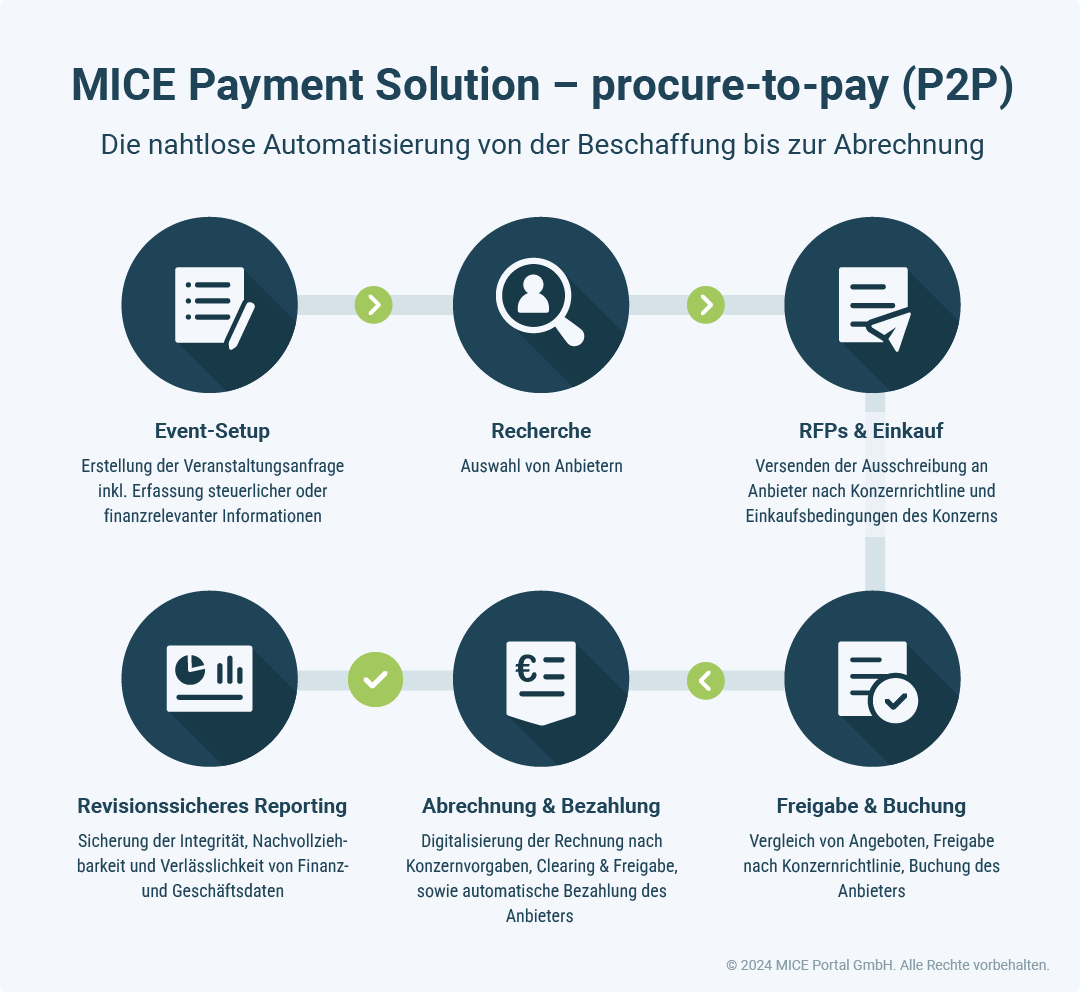
MICE payment solution - Procure-to-Pay (P2P) in strategic event purchasing
Pay Smart, Be Smart: In the age of digitalization, companies are increasingly looking for efficient solutions to optimize their internal processes. A digital purchasing and billing solution is becoming increasingly important, especially when it comes to purchasing MICE services. The aim is to map the entire process - from procurement to invoicing (P2P, Procure-to-Pay) - seamlessly and automatically.
Crucial data, such as the type of event, can be recorded as early as the purchasing stage so that tax requirements can be taken into account directly during booking. The handling of different invoice formats, which are common in the hotel industry, is particularly challenging. Efficient invoice clearing can save considerable time and resources with specialized software solutions.
A holistic, user-friendly purchasing and invoicing solution not only increases the efficiency of internal processes, but also helps to strengthen the company's competitiveness. With such solutions, companies are optimally prepared for the challenges of strategic event purchasing in the digital future.
5. Manage MICE efficiently
While MICE offers enormous opportunities, it is important to bear in mind that the planning and implementation of such events is both complex and time-consuming. Many companies are faced with the challenge of maintaining an overview: How do you organize events that are both effective and budget-friendly? Which tools and technologies can simplify processes? And how do you ensure that every event delivers the desired ROI (Return on Investment)?
This is where MICE management comes into play - an approach that aims to effectively link and sustainably optimize the processes surrounding planning, execution and follow-up. With the right strategy and the right solutions, companies can fully exploit the potential of the MICE industry.

More about MICE Management
Explore our Customer Success Stories
Learn how leading companies achieve outstanding results with MICE Portal